


- By Admin
- 2026/5/20
ZSMOLD Cap Mold Cooling Design: Achieving Temperature Uniformity Under 2°C
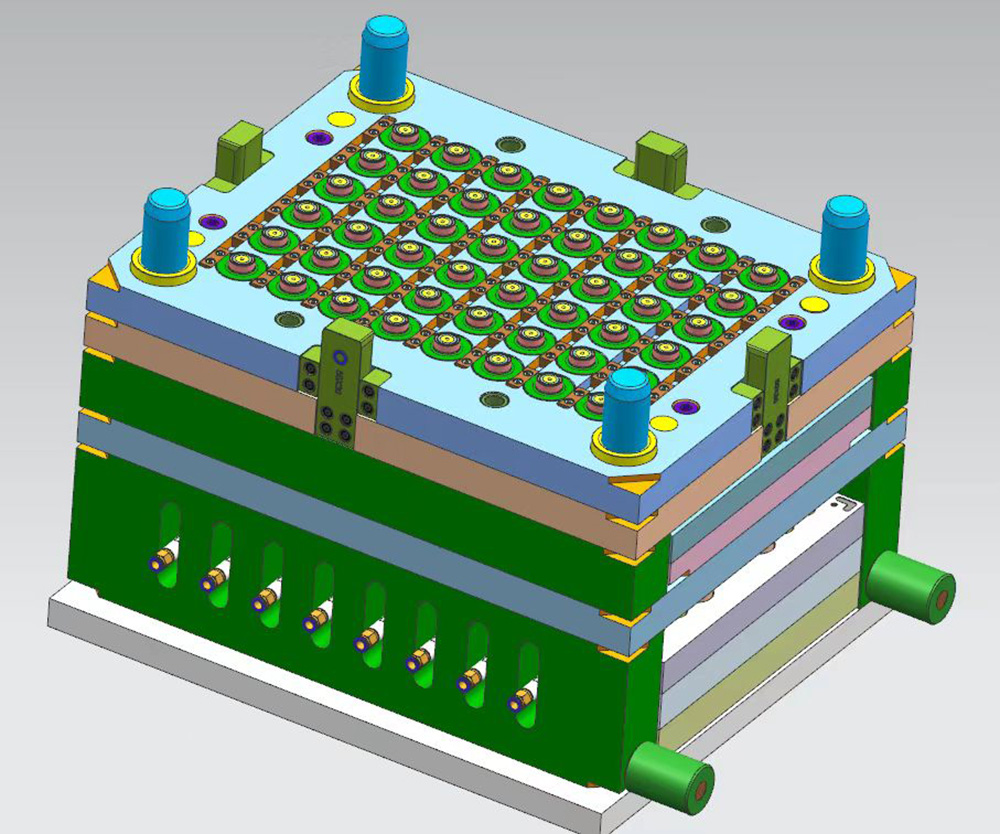
Cooling is the most critical factor in cap molding — yet it is often the most overlooked. Inconsistent cooling creates temperature differences across cavities and within individual cavities. Those differences translate directly into weight variation, dimensional instability, warpage, and extended cycle times.
Most standard cap molds struggle to maintain temperature differences below 5–8°C between cavities. ZSMOLD has engineered a cooling design that consistently achieves temperature uniformity under 2°C across all cavities. This article reveals how.
Why Temperature Uniformity Matters in Cap Molding
Even small temperature differences create significant quality problems:
| Temperature Variation | Consequence |
|---|---|
| >2°C | Visible differences in cap appearance, inconsistent torque |
| >4°C | Warpage in tamper bands, liner adhesion problems |
| >6°C | Dimensional variation (caps fail capping machine feeding) |
| >8°C | Crystallinity differences, brittle caps, field failures |
In high-volume cap production — running millions of caps per day — temperature uniformity is not optional. It is essential for quality, consistency, and profitability.
The Challenge: Why Most Cap Molds Fail at Thermal Uniformity
Traditional Cooling Limitations
Standard cap molds use straight-drilled cooling channels. These channels follow simple straight lines because they are made with conventional drilling equipment. The limitations are severe:
| Limitation | Consequence |
|---|---|
| Uneven distance from cavity surface | Hot spots and cold spots within the same cavity |
| Poor cooling in complex areas | Thick sections (hinges, tamper bands) overheat |
| Cavity-to-cavity variation | Outer cavities cool slower than center cavities |
| Dead zones | Stagnant coolant where deposits form |
Cap-Specific Challenges
Cap molds face unique cooling challenges:
Complex geometry: Caps have thin walls, thick hinges, tamper bands, and liner areas — all requiring different cooling rates
High cavitation: 48, 64, or 96 cavities amplify any thermal imbalance
Fast cycles: Short cycle times demand rapid, uniform heat removal
Multiple materials: HDPE, PP, and PET have different thermal properties
ZSMOLD Cooling Design: Core Technologies
Technology 1: Conformal Cooling for Caps
What it is: Conformal cooling means the cooling channel follows the shape of the cap cavity. Instead of straight lines, ZSMOLD cooling channels curve and contour to maintain a constant distance from the cavity surface at every point.
How ZSMOLD implements it:
5-axis CNC machining creates channels that mirror cap geometry
Channel-to-cavity distance optimized for each cap feature (8–12mm typical)
Channels placed specifically behind thick sections (hinges, tamper bands)
| Cap Feature | Cooling Priority | ZSMOLD Channel Placement |
|---|---|---|
| Top surface | Medium | Follows dome contour |
| Side wall | High | Spirals around circumference |
| Tamper band | Critical | Concentrated channels behind band |
| Hinge area | Critical | Localized high-flow channels |
| Liner seat | Medium | Continuous ring channel |
The result: Every part of every cavity receives the same cooling intensity — eliminating hot spots and cold spots.
Technology 2: Zoned Cooling Circuit Design
What it is: Instead of one long cooling path for all cavities, ZSMOLD divides the mold into independent cooling zones. Each zone has its own optimized channel geometry and, on high-cavity molds, independent flow control.
ZSMOLD zone strategy for cap molds:
| Zone | Location | Cooling Priority | Channel Design |
|---|---|---|---|
| Zone 1 | Tamper band area | Highest — most material thickness | High-density, high-flow channels |
| Zone 2 | Side wall | High — critical for dimensional stability | Spiral or annular channels |
| Zone 3 | Top surface | Medium — thinner section | Standard spacing |
| Zone 4 | Hinge area | Highest — moving part requires stability | Localized intensified cooling |
| Zone 5 | Liner seat | Medium-high — affects liner adhesion | Continuous ring channel |
The result: Each cap feature receives exactly the cooling it needs — no more, no less.
Technology 3: High-Turbulence Flow Design
What it is: Straight channels often produce laminar flow, where hot coolant stays against the channel wall, acting as an insulator. Turbulent flow mixes the coolant continuously, bringing hot coolant to the channel surface for much faster heat transfer.
ZSMOLD turbulent flow design:
Baffles and turbulators create turbulence in key zones
Flow rates optimized for Reynolds number > 10,000 (fully turbulent)
Cross-section variations disrupt thermal boundary layers
Heat transfer comparison:
| Flow Type | Heat Transfer Coefficient | Cooling Efficiency |
|---|---|---|
| Laminar | Low (500–1000 W/m²K) | Poor |
| Transitional | Medium (1000–3000 W/m²K) | Acceptable |
| Turbulent (ZSMOLD) | High (3000–8000 W/m²K) | Excellent |
The result: Turbulent flow removes heat 2–3 times faster than laminar flow, enabling shorter cycle times without sacrificing uniformity.
Technology 4: Balanced Manifold Cooling
What it is: In multi-cavity cap molds, the hot runner manifold sits directly behind the cavities. If the manifold heats the mold unevenly, temperature uniformity is impossible.
ZSMOLD manifold cooling design:
Thermal isolation between hot manifold and cool mold plates
Dedicated cooling circuits for the area behind cavities
Insulation plates to block heat transfer where needed
The result: Cavities are not fighting against heat from the manifold. The mold runs cool and uniform.
Technology 5: Real-Time Temperature Monitoring Integration
What it is: ZSMOLD cap molds can be equipped with embedded thermocouples at multiple locations. Operators see actual cavity temperatures in real time, not just coolant temperatures.
Monitoring points:
Inlet and outlet coolant temperature (each zone)
Steel temperature behind each cavity group
Differential temperature across the mold
The result: If temperature begins to drift, operators know immediately. Problems are corrected before they affect cap quality.
Verification: How ZSMOLD Validates Cooling Uniformity
Before any ZSMOLD cap mold ships, it must pass rigorous cooling validation:
Step 1: Thermal Simulation
CAE analysis predicts temperature distribution across all cavities. We iterate the cooling design until simulation shows temperature variation below 1.5°C.
Step 2: In-Mold Temperature Mapping
Instrumented test runs use multiple thermocouples to map actual temperatures. Acceptance criteria:
| Measurement Point | Acceptance Criteria |
|---|---|
| Cavity-to-cavity variation | <2.0°C |
| Within-cavity variation | <1.5°C |
| Steady-state stability | ±0.5°C over 1 hour |
Step 3: Cap Quality Correlation
Final validation compares thermal data to actual cap quality:
Cap weight variation must be under 0.8%
Cap dimensions must be consistent across all cavities
No warpage, sink marks, or stress lines
Real-World Results: 48-Cavity HDPE Beverage Cap Mold
Customer: Bottled water company producing 500 million caps annually
Previous mold (standard cooling):
Temperature variation: 6.8°C (cavity 1 to cavity 48)
Cycle time: 9.2 seconds
Cap weight variation: ±0.11g
Rejection rate: 2.1%
ZSMOLD conformal cooling design:
6 independent cooling zones
Conformal channels in tamper band and hinge areas
Turbulent flow design (Reynolds > 12,000)
Results:
| Metric | Before | After | Improvement |
|---|---|---|---|
| Cavity temperature variation | 6.8°C | 1.4°C | 79% reduction |
| Cycle time | 9.2 sec | 6.8 sec | 26% faster |
| Cap weight variation | ±0.11g | ±0.03g | 73% reduction |
| Rejection rate | 2.1% | 0.3% | 86% reduction |
| Annual material savings | — | 23 tons | $27,600/year |
Customer quote: "We were skeptical that cooling could make such a difference. The ZSMOLD mold runs cooler and more uniform than anything we have seen. Our caps finally look identical."
Comparison: ZSMOLD vs. Standard Cooling Design
| Parameter | Standard Cap Mold | ZSMOLD Cap Mold |
|---|---|---|
| Cooling channel type | Straight drilled | Conformal (3D machined) |
| Cooling zones | 1–2 zones | 5–6 zones |
| Temperature variation | 5–10°C | <2°C |
| Flow regime | Laminar (Re < 4000) | Turbulent (Re > 10,000) |
| Cycle time reduction potential | Baseline | 15–30% faster |
| Cap quality consistency | Variable | Excellent |
Additional Benefits of Uniform Cooling
When ZSMOLD achieves temperature uniformity under 2°C, other benefits follow automatically:
| Benefit | Explanation |
|---|---|
| Faster start-up | All cavities reach steady temperature together |
| Wider processing window | Less sensitive to material or ambient changes |
| Longer mold life | Eliminating hot spots reduces thermal fatigue |
| Lower energy cost | More efficient cooling allows chiller setpoint 2–3°C higher |
| Simplified troubleshooting | Thermal problems are eliminated as a variable |
Material-Specific Cooling Considerations
ZSMOLD tailors cooling designs for each cap material:
| Material | Cooling Challenge | ZSMOLD Solution |
|---|---|---|
| HDPE | Slow crystallization, prone to warpage | Extended cooling time, uniform temperature critical |
| PP | Low thermal conductivity | Conformal channels closer to cavity (6–8mm) |
| PET | Fast crystallization, becomes brittle if over-cooled | Precise temperature control, moderate cooling intensity |
Conclusion
Achieving temperature uniformity under 2°C in a cap mold is not magic. It is the result of conformal cooling channel design, zoned circuits, turbulent flow optimization, manifold thermal management, and rigorous validation. ZSMOLD has mastered these technologies to deliver cooling performance that most mold makers cannot match.
If your caps show weight variation, warpage, inconsistent torque, or if you simply want faster cycles without sacrificing quality — ZSMOLD cooling design is the answer.
Contact ZSMOLD today for a cooling analysis of your existing cap molds. We will measure your current temperature uniformity and show you exactly how much better performance you can achieve.