


- By Admin
- 2026/4/1
How to Fix Preform Whitening and Bubbles: zsmold Mold Process Optimization Guide
In PET preform manufacturing, clarity is quality. Consumers expect crystal-clear bottles, and that clarity begins with the preform. Yet two of the most common—and frustrating—defects that plague preform production are whitening (also known as gate blush or stress whitening) and bubbles (voids or gas pockets within the preform wall).
These defects are not merely cosmetic. They indicate:
Process instability that can affect entire production runs
Material degradation that compromises bottle strength
Weak points that may fail during blow molding
Increased rejection rates and material waste
At zsmold, we have dedicated ourselves to understanding and eliminating these defects. This comprehensive guide explores the root causes of whitening and bubbles—and provides practical, proven solutions through advanced mold technology and process optimization.
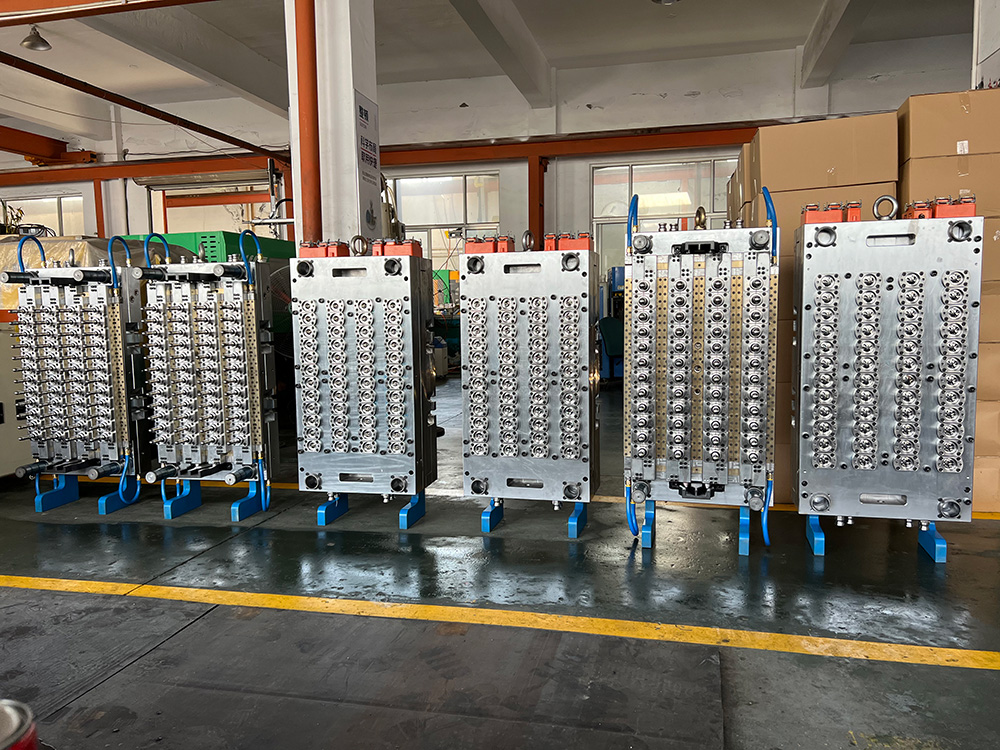
Understanding the Defects: Whitening and Bubbles
Preform Whitening (Gate Blush / Stress Whitening)
What it looks like:
Milky white, hazy, or cloudy area surrounding the gate (injection point)
Can appear as a ring around the gate or as a diffuse haze
Most common in the base area, but can extend into the preform body
What causes it:
Excessive shear heating during injection
Rapid temperature fluctuations in the gate area
Insufficient cooling allowing crystallization
Residual stress from improper packing or ejection
Why it matters:
Weakens the bottle base during blow molding
Creates visible defects in finished bottles
Indicates improper material processing
Preform Bubbles (Voids / Gas Pockets)
What it looks like:
Small, spherical voids visible inside the preform wall
Can be isolated bubbles or clusters
Most common in thick sections (gate area) or at flow fronts
What causes it:
Trapped moisture in PET resin (above 50 ppm)
Air entrapment during injection
Insufficient packing pressure causing shrinkage voids
Material degradation releasing gases
Improper screw design causing air ingestion
Why it matters:
Creates weak points that may fail under pressure
Affects optical clarity of finished bottles
Indicates material or process issues
Root Cause 1: Moisture in PET Resin
PET is hygroscopic, meaning it readily absorbs moisture from the air. When moisture-laden resin is processed, the water turns to steam at injection temperatures—creating bubbles and causing hydrolytic degradation.
The Problem:
| Moisture Level | Consequence |
|---|---|
| < 50 ppm | Safe processing, clear preforms |
| 50–100 ppm | Occasional bubbles, reduced IV |
| > 100 ppm | Frequent bubbles, severe haze, brittleness |
zsmold Solution: Material Handling Recommendations
Drying Parameters:
| Parameter | Recommended Setting |
|---|---|
| Drying Temperature | 160–180°C (depending on resin) |
| Drying Time | 4–6 hours |
| Dew Point | -40°C or lower |
| Moisture Content Target | < 0.005% (50 ppm) |
Best Practices:
Use desiccant dryers with continuous monitoring
Avoid over-drying (can cause degradation)
Protect dried resin from ambient moisture during transfer
Clean drying hoppers regularly to prevent contamination
Root Cause 2: Improper Gate Design and Cooling
The gate area—where molten PET enters the cavity—is the most challenging region in preform molding. It is the thickest section, experiences the highest shear, and has the most complex cooling requirements.
How Gate Issues Cause Defects:
| Issue | Resulting Defect |
|---|---|
| Gate too small | Excessive shear → whitening, degradation |
| Gate too large | Poor gate seal → voids, sink marks |
| Insufficient gate cooling | Crystallization → whitening |
| Uneven gate cooling | Stress → whitening, warpage |
zsmold Solution: Precision Gate Design
Optimized Gate Geometry:
Gate diameter carefully calculated based on preform weight and material
Tapered design to minimize shear stress
Smooth transitions to prevent flow turbulence
Advanced Gate Cooling:
Beryllium copper gate inserts with 5–10x higher thermal conductivity than steel
Conformal cooling channels wrapping around the gate area
Dedicated cooling circuits for the gate region
Valve Gate Technology:
Precise gate opening and closing to control melt flow
Clean gate marks that stretch uniformly during blow molding
Reduced shear stress compared to thermal gates
Root Cause 3: Injection Speed and Pressure Issues
The way PET is injected into the cavity directly affects both whitening and bubble formation.
How Injection Parameters Affect Quality:
| Parameter Issue | Resulting Defect |
|---|---|
| Injection speed too high | Excessive shear → whitening, degradation |
| Injection speed too low | Premature freezing → flow marks, bubbles |
| Insufficient packing pressure | Shrinkage voids → bubbles |
| Excessive packing pressure | Stress → whitening, ejection issues |
zsmold Solution: Process Parameter Optimization
Recommended Injection Parameters:
| Parameter | Recommended Range | Purpose |
|---|---|---|
| Injection Speed | Moderate (controlled) | Minimize shear, ensure complete fill |
| Injection Pressure | 800–1500 bar | Achieve full cavity fill |
| Packing Pressure | 600–1000 bar | Compensate for shrinkage |
| Packing Time | Until gate freeze | Prevent backflow |
| Cooling Time | Sufficient for ejection | Prevent post-mold distortion |
ZSMOLD Process Support:
DOE (Design of Experiments) support to identify optimal parameters
Process monitoring recommendations for consistency
Scientific molding principles for robust production
Root Cause 4: Melt Temperature and Thermal Profile
PET melt temperature must be carefully controlled—too hot causes degradation and bubbles, too cold causes flow issues and stress.
Temperature Guidelines:
| Parameter | Recommended Range |
|---|---|
| Barrel Temperatures | 260–280°C (zone dependent) |
| Melt Temperature | 265–275°C (measured) |
| Hot Runner Temperature | 260–270°C |
| Mold Temperature | 5–15°C (cooling) |
zsmold Solution: Advanced Thermal Management
Precision Hot Runner Systems:
Individual nozzle temperature control for each cavity
Balanced flow channels for consistent melt delivery
Thermocouple placement for accurate temperature monitoring
Uniform Mold Cooling:
Conformal cooling channels following preform contour
Zone-specific cooling circuits for neck, body, and gate
CFD-optimized cooling design to eliminate hotspots
Root Cause 5: Venting Issues
Trapped air in the cavity can cause bubbles, burn marks, and incomplete filling.
How Venting Affects Quality:
| Venting Issue | Resulting Defect |
|---|---|
| Insufficient venting | Air entrapment → bubbles, burn marks |
| Clogged vents | Trapped air → incomplete filling |
| Improper vent depth | Flash or inadequate venting |
zsmold Solution: Precision Venting Design
Strategic Vent Placement:
Last fill points where melt fronts meet
Deep ribs and complex geometry where air accumulates
Gate area where air must escape during filling
Optimized Vent Dimensions:
| Vent Location | Recommended Depth |
|---|---|
| Primary vents | 0.03–0.05mm |
| Secondary vents | 0.02–0.03mm |
| Ejector pin vents | 0.02–0.04mm |
Self-Cleaning Vent Designs:
Vented ejector pins that clean during each cycle
Accessible vents for easy maintenance
Corrosion-resistant materials to prevent vent degradation
Root Cause 6: Screw and Barrel Design
Improper screw design can cause air ingestion, melt degradation, and inconsistent melt quality.
zsmold Solution: Equipment Recommendations
Screw Design Considerations:
Compression ratio appropriate for PET (typically 2.5–3.0:1)
L/D ratio of 20–25:1 for adequate mixing
Barrier flight designs for improved melt quality
Operation Best Practices:
Back pressure of 10–30 bar for melt consistency
Screw speed of 50–80 RPM to minimize shear
Decompression (suck back) to prevent drool
Root Cause 7: Contamination and Recycled Material
Contaminants or inconsistent recycled material can cause bubbles, whitening, and other defects.
zsmold Solution: Material Quality Recommendations
| Factor | Recommendation |
|---|---|
| Virgin Material | Use high-quality PET with consistent IV |
| Recycled Content | Limit to 25–50% depending on application |
| IV Range | Maintain 0.75–0.85 dL/g for water bottles; higher for carbonated |
| Contamination | Use screens and magnets to remove foreign material |
| Color Concentrates | Ensure compatibility with base resin |
The zsmold Process Optimization Checklist
Use this systematic checklist to eliminate whitening and bubbles:
Material Preparation
Verify drying temperature (160–180°C)
Confirm drying time (4–6 hours)
Check moisture content (< 50 ppm)
Inspect material for contamination
Mold Condition
Verify gate dimensions and condition
Inspect gate cooling (beryllium copper inserts)
Check vent depths and cleanliness
Verify cooling circuit flow and temperature
Inspect mold alignment and closure
Machine Settings
Verify barrel temperatures (260–280°C)
Check melt temperature (265–275°C)
Optimize injection speed profile
Set packing pressure and time appropriately
Verify cooling time for complete solidification
Check screw speed and back pressure
Process Validation
Conduct short-shot study to verify filling pattern
Perform pressure drop study
Check cavity-to-cavity weight variation
Inspect preforms under proper lighting for defects
Document optimal parameters for repeatability
Real-World Results: What zsmold Customers Experience
Manufacturers using zsmold molds with optimized processes consistently report:
| Defect | Industry Average | zsmold Performance |
|---|---|---|
| Whitening (Gate Blush) | 3–8% | <0.5% |
| Bubbles/Voids | 1–3% | <0.2% |
| Overall Rejection Rate | 5–10% | <2% |
| First-Pass Yield | 85–92% | 97–99% |
| Cavity-to-Cavity Weight Variation | ±0.2–0.3g | ±0.1g |
Conclusion: Crystal-Clear Preforms, Every Cycle
Whitening and bubble defects in PET preforms are not inevitable. With proper material handling, advanced mold design, optimized process parameters, and rigorous quality control, manufacturers can achieve crystal-clear, defect-free preforms consistently.
At zsmold, we provide not only world-class preform molds but also the process expertise to help our customers succeed. From precision gate design and conformal cooling to vent optimization and process support, our comprehensive approach to mold technology delivers results you can see—and your customers will appreciate.
Whether you produce preforms for bottled water, carbonated beverages, hot-fill applications, or specialty packaging, zsmold molds and expertise help you eliminate defects and elevate product quality.
Choose zsmold. Choose clarity. Choose quality.